
TL;DR
In Season 1, Episode 4 of Fixer to Fabulous, Dave and Jenny Marrs repurposed a vintage window awning as a decorative range hood cover in a kitchen renovation. The idea offers a distinctive alternative to a standard hood, but building around a kitchen vent involves planning and may require professional help.
Dave and Jenny Marrs turned a vintage, scalloped window awning into a decorative range hood cover in Season 1, Episode 4 of Fixer to Fabulous, offering a playful alternative to a conventional kitchen hood. The design was part of a renovation honoring the homeowner’s grandmother, and it shows how a prominent fixture can become a personalized feature rather than blending into the cabinetry.

Get furniture and decor delivered free with Prime
- Fast, free delivery on millions of items
- Prime Video, Amazon Music and more included
- Member-only deals all year
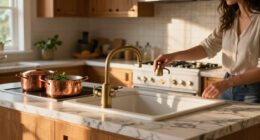
For the kitchen, the Marrs sourced an old metal window awning similar to awnings that had been used on the home’s exterior. They fitted it around the kitchen vent, creating a canopy-like cover with slatted panels and a scalloped edge. The awning acted as the visible design element; the kitchen still needed a vent for cooking fumes.
The renovation drew on the homeowner Lisa’s memories of her grandmother. Jenny Marrs wrote on the couple’s blog that the design included cabinetry with a pickled finish as an ode to her, alongside the repurposed awning as an unexpected farmhouse detail. Lisa recognized the feature from her grandmother’s home and said in the episode, “This is so cute, because my granny used to have one of those over that window.”
The concept could be adapted with a found awning or a newly built cover, but the decorative shell is only one part of the job. The vent must be selected and installed for the kitchen, and any cover must fit around it without interfering with its operation. A ducted hood sends air outside; a ductless model filters and recirculates air and requires regular filter changes.
Make the Range Hood a Personal Feature
Dave and Jenny Marrs turned a vintage awning into a playful range hood cover. The design adds character, while the kitchen still needs a properly planned, working vent.
The Marrs’ Approach
In Fixer to Fabulous Season 1, Episode 4, an old metal awning became a canopy around the kitchen vent.
Vintage awning
Its scalloped edge and slatted panels made the hood cover an unexpected farmhouse feature.
A nod to Granny
The awning and pickled-finish cabinetry reflected the homeowner’s memories of her grandmother.
Choose the Vent First
The decorative cover surrounds the ventilation unit; it does not replace it.
- Sends air outside.
- Plan the cover around the selected unit.
- Filters and recirculates air.
- Filters need regular replacement.
Adapt the Look
A found awning is only one option; the design should suit the kitchen and vent.
Measure the vent and assess whether a vintage awning’s materials and dimensions are suitable.
A paneled design, including tongue-and-groove MDF, can offer a related look.
Follow hood instructions and local requirements; consult licensed professionals for work beyond your qualifications.
A Hood That Becomes a Design Feature
A range hood sits in a prominent position over the cooktop, so its cover can shape how the whole kitchen looks. The Marrs’ project shows one way to make that area feel custom and connected to a home’s story, rather than treating it as a standard metal appliance. In this case, the awning’s shape and finish also echoed the renovation’s farmhouse character and the homeowner’s memories.
For readers planning a kitchen update, the practical lesson is to settle the ventilation plan before designing the cover. A decorative piece does not replace an effective vent, and a cover needs to accommodate the chosen unit. That distinction can help avoid building an attractive feature that obstructs the appliance or needs costly reworking.
The approach is inspiration, not a universal design prescription. A vintage awning may suit some kitchens but not others, and its dimensions, condition, materials and compatibility with a vent need to be checked. A simpler paneled cover could offer a related look when an antique piece is unavailable or unsuitable.
Products Worth Considering

Levoit Core 600S-P Smart Air Purifier for Large Rooms up to 2933 ft²

Sonos Era 100 Wireless Smart Speaker with Alexa, Black

Dyson Airwrap Co-anda2x Multi-Styler and Dryer (2026 Model)
As an affiliate, we earn on qualifying purchases.
The Family Story Behind the Awning
The episode’s design choices were tied to the homeowner’s family history. Lisa had inherited her grandmother’s property, and Jenny described the grandmother as someone who spent time in the kitchen, garden and root cellar preserving vegetables. The renovation referenced that history through the cabinetry’s pickled finish and the awning, a feature Lisa remembered seeing at her grandmother’s home.
The project’s appeal comes from using an object associated with the house’s character in an unexpected way. A window awning is usually an exterior feature; here, the Marrs used one as the visible enclosure around a kitchen vent. The result was a canopy-style hood that brought an individual detail into the kitchen rather than relying on a generic builder-grade finish.
For a similar look, the design could be interpreted rather than copied exactly. A homeowner might use a suitable vintage awning or build a panelled cover with materials such as tongue-and-groove MDF, as suggested in the renovation guidance. The choice depends on the room, the vent and the materials’ suitability for the location.
“We stained the cabinetry in a pickled finish as an ode to Granny, incorporated an old awning as the range hood for an unexpected pop of farmhouse character.”
— Jenny Marrs, writing on the Marrs’ blog
Ventilation and Installation Details
The available account does not specify the vent model, its airflow rating, the exact installation method or whether the kitchen used ducted or ductless ventilation. It also does not provide measurements, a materials list or step-by-step instructions for reproducing the Marrs’ cover. Those details matter: a vintage awning may not fit a particular vent or kitchen, and its condition and materials would need to be evaluated before use.
The project is described as a substantial DIY undertaking, but no cost, timeline or code requirements are given. Requirements vary by location and the specific installation. Homeowners should check applicable building rules and the vent manufacturer’s instructions before work begins, rather than assuming the decorative design can be installed around any hood.
Plan the Vent Before the Cover
Anyone considering a similar feature should begin by identifying the kitchen’s ventilation needs and selecting a compatible hood. If an existing vent already exhausts air outdoors, the cover can be designed around it; a ductless unit instead filters and recirculates air, with filters that need routine replacement. The specific choice depends on the room and the appliance.
Next, measure the vent and plan a secure support structure and cover that leave the appliance working as intended. A vintage awning is one option; a built-in paneled design is another. Before cutting or mounting materials, check the hood instructions, local requirements and the suitability of the materials for the installation. For electrical, structural or ductwork tasks beyond a homeowner’s qualifications, consult licensed professionals and follow relevant safety steps.
No further episode, product launch or formal DIY plan is reported. For now, the Marrs’ kitchen serves as an example of a design idea: make the hood cover distinctive, while treating ventilation and safe installation as separate, essential parts of the project.
Source: rss
Key Questions
What did Dave and Jenny Marrs use as a range hood cover?
They repurposed a vintage, scalloped metal window awning as a decorative cover fitted around a kitchen vent in Fixer to Fabulous Season 1, Episode 4.
Did the awning replace the kitchen vent?
No. The awning served as the visible cover around the vent. A kitchen still needs an appropriately selected and installed ventilation unit.
Can I use a ductless vent with a custom hood cover?
A ductless unit may be an option, but it filters and recirculates air rather than exhausting it outdoors. The cover must fit the selected unit and allow it to operate as intended; filters also need regular replacement.
What could I use instead of a vintage awning?
A built-in panelled cover, including one made with tongue-and-groove MDF, could create a related country-inspired look. Material choice and construction should suit the vent and the installation requirements.
Is this a simple DIY project?
The project is described as a substantial undertaking. Planning the vent, support frame and cover takes care, and local requirements may apply. Use licensed professionals for work outside your qualifications, including relevant electrical, structural or ductwork tasks.
Source: hunker.com