TL;DR

Get furniture and decor delivered free with Prime
- Fast, free delivery on millions of items
- Prime Video, Amazon Music and more included
- Member-only deals all year
A Hunker report describes using a macrame panel as a decorative way to add partial privacy to a patio or yard without installing a traditional fence or hedge. The DIY approach calls for roughly 200 yards of synthetic or weather-treated cord per 2-by-5-foot panel, plus a suitable support; durability, privacy level and local requirements depend on the specific setup.
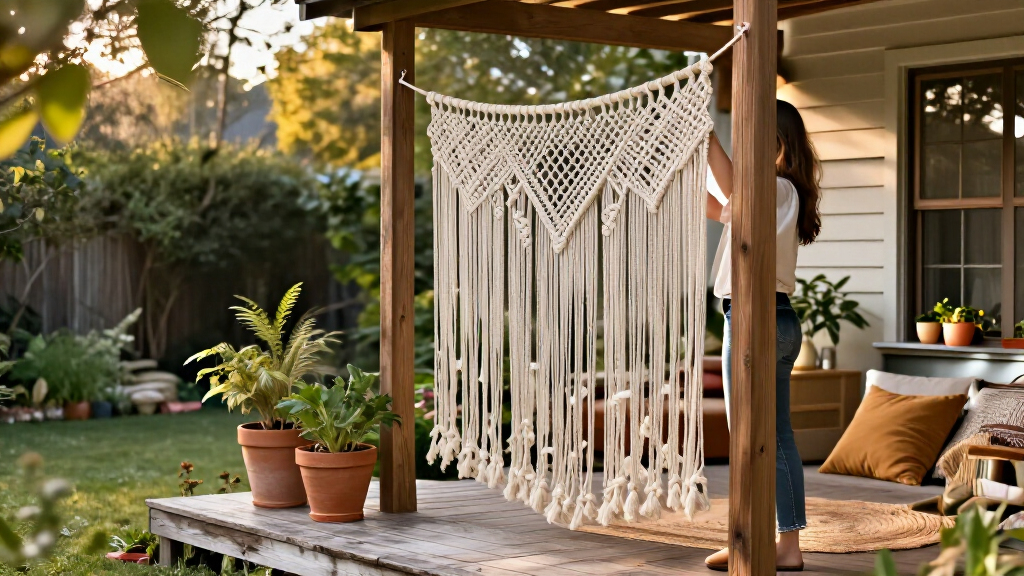
Hunker has outlined a do-it-yourself macrame screen as a decorative way to add some privacy to a yard or patio without putting up a conventional fence or hedge. The report describes a hanging woven panel supported by a rod, frame or pergola, giving homeowners a flexible option for screening outdoor spaces while adding a handmade design element, much like this old-fashioned backyard privacy solution.
The project uses about 200 yards of synthetic or weather-treated cord for each panel measuring roughly 2 by 5 feet, according to Hunker. The material hangs from a wooden or metal support, which could be a curtain rod or part of a pergola. Heavy-duty hooks, eye screws, brackets or zip ties may be used to secure the support, depending on the installation.
Hunker says to measure the intended panel length and cut cords at about twice that length. Each cord is folded in half and attached to the upper bar with a lark’s head knot; the strands are then woven into rows using a chosen pattern. The report recommends planning for extra cord because material needs vary with the screen’s dimensions and construction, and unused supplies may be returnable.
The screen can be made as a fixed panel or a hanging curtain, and its pattern can be adjusted or embellished with beads and plant hangers. Hunker also describes using a folding room-divider frame to move the screen when needed. For outdoor use, materials and supports need to suit exposure to weather and the weight of the finished panel.
A Screen Without a Full Fence
A macrame panel offers a middle ground for people who want some visual separation without enclosing an entire yard. It may suit a patio, seating area or outdoor nook where a full fence would be more structure than the homeowner wants. Unlike a permanent boundary, a curtain-style screen or portable divider can be limited to one location and, in some arrangements, moved when privacy is not needed.
The trade-off is that a woven panel is not automatically equivalent to a fence. Its coverage depends on the pattern, dimensions and placement, and it may not block views as completely as a solid barrier. The proposal is primarily a decorative privacy option; the source does not provide testing or evidence about how much privacy a particular design achieves, how long it lasts outdoors or whether it can serve as a boundary or safety barrier.
For homeowners, the practical questions are therefore as important as the appearance: whether the support can carry the panel, how exposed the location is to wind and rain, and whether any local rules apply to the installation. A DIY screen may be less involved than building a fence, but its attachment still needs to be appropriate for the site.
outdoor weather-resistant macrame cord
As an affiliate, we earn on qualifying purchases.
As an affiliate, we earn on qualifying purchases.
How the Macrame Panel Works
Macrame is a technique for making textiles by knotting cord. Hunker presents it as a craft that can combine decoration and screening, with the panel’s look shaped by the chosen knots and pattern. The report also notes that the practice has a history dating to the 13th century and describes it as having both decorative and functional uses.
The proposed installation begins with a support fixed across the area to be screened. The cords are attached to that bar, then knotted into a panel of the desired length. Hunker points readers to pattern examples, including one by Rachel of A Beautiful Mess and tutorials by Deepa Rai on YouTube. These are presented as inspiration and instructions; the report does not identify one required pattern or guarantee that a particular design will suit every space.
There are several ways to adapt the concept: use a curtain-like hanging, incorporate plant hangers, add planters at the base, or mount the work on a folding divider frame. A frame intended for indoor use may need weatherproofing before being placed outdoors, according to the report. Materials and mounting differ by design, so the stated cord quantity is an estimate for one panel size, not a universal shopping list.
Durability and Coverage Depend on Setup
The Hunker report does not specify how long the screen will last in different climates, how much wind or rain it can withstand, or how much visibility it blocks. Those outcomes will depend on the cord, knot pattern, panel density, support and exposure. It also does not provide a cost estimate, despite describing the project as budget-friendly, or a measured comparison with the cost of fencing.
Homeowners should check that the mounting surface and fasteners can bear the panel’s weight and account for outdoor conditions. The source does not address local building codes, property-line rules or restrictions that may apply to fences and outdoor structures. Whether any of those rules cover a temporary or hanging screen will depend on local requirements and the specific installation.
Plan the Site Before Knotting
The next step for anyone considering the idea is to measure the space and decide whether the screen will hang from a fixed rod, pergola or movable frame. That choice affects the cord length, support hardware and the amount of coverage. Hunker advises buying more cord than the initial estimate suggests and keeping the receipt in case some can be returned.
Before attaching anything, homeowners should select cord suited to outdoor exposure and confirm that the rod, brackets and attachment points can safely hold the finished panel. They can then choose a knot pattern, make a sample or panel, and adjust the design as they work. The source does not announce a follow-up test or product launch; the practical outcome will depend on each homeowner’s materials, installation and local rules.
Key Questions
How much cord does one macrame privacy panel require?
Hunker estimates about 200 yards of synthetic or weather-treated fabric cord for a panel roughly 2 by 5 feet. The amount can change with the pattern, panel size and construction, so the figure is a guide rather than a fixed requirement.
Can a macrame screen replace a traditional fence?
Not necessarily. The report presents it as a way to add some privacy, but does not establish that it provides the same coverage, durability, boundary function or safety as a fence. Its suitability depends on what the homeowner needs from the barrier.
What can support an outdoor macrame screen?
Possible supports include a curtain rod, wooden or metal pole, pergola or folding divider frame. Hunker says the support should be secured with suitable hardware, such as hooks or brackets. The correct choice depends on the installation and the weight of the finished panel.
Can a macrame room divider be used outside?
Hunker says a folding room-divider frame can be used to make a movable outdoor screen, but notes that it may need weatherproofing. The report does not specify a particular treatment or rate the frame’s durability in outdoor conditions.
Source: rss
Fall Picks
fall essentials
As an affiliate, we earn on qualifying purchases.