
TL;DR

Get furniture and decor delivered free with Prime
- Fast, free delivery on millions of items
- Prime Video, Amazon Music and more included
- Member-only deals all year
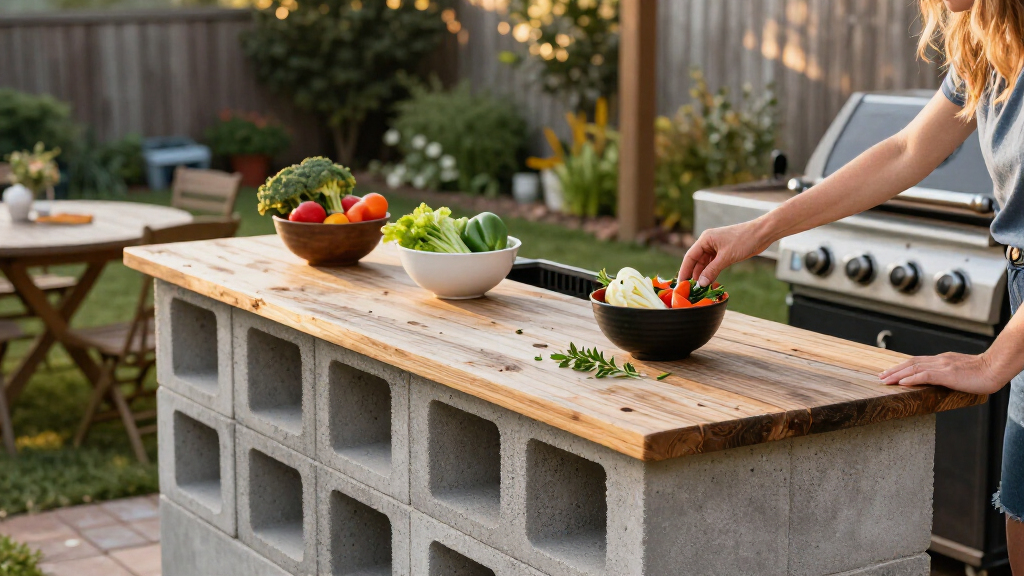
A video series by YouTuber Mr. Greg’s How To shows an L-shaped outdoor grill counter built from several sizes of concrete blocks and concrete bricks. The blocks are dry-stacked around a grill, with surface-bonding cement used to secure and coat the structure; the project’s final cost and safety details are not reported.
A video series from Mr. Greg’s How To shows a DIY outdoor grill counter built from concrete blocks and bricks, arranged in an L shape around a grill. The build offers a modular alternative to a professionally installed outdoor kitchen, though the report does not provide a final project cost or independent assessment of the finished structure.
According to Hunker’s report, the project begins with a concrete foundation already in place. The creator removes the grill’s side shelves, then dry-stacks blocks around it to form a counter with a recessed opening for the appliance. The reported materials include standard 8-by-8-by-16-inch hollow blocks, solid blocks in two thinner sizes, half blocks and concrete bricks.
Before securing the base, the creator outlines its position with chalk. Surface-bonding cement is applied along the base blocks, while the remaining blocks are stacked in the planned arrangement. The report says more of the cement is then applied as an outer coating to hold the blocks together, rather than using mortar between each unit. It describes the cement as a product with added fiber intended to improve rigidity.
The report presents the method as a way to customize a grill station to a yard’s layout. It does not provide measurements for the completed counter, a materials list with quantities, a full project budget, or details about how the structure was tested or secured to the foundation.
A Modular Alternative to Built Kitchens
The build’s appeal is its use of individual, rearrangeable units. A homeowner can test a layout before applying cement, and different block sizes can help shape the grill opening and counter footprint. That flexibility may suit spaces where a fixed, prefabricated kitchen would be difficult to fit.
Cost is another potential draw, but the figures in the report are material-price examples, not a project estimate. It cites a standard concrete block at just over $2 and a 50-pound bag of surface-bonding cement at under $20, while noting that the total varies with project size. It also cites Range Outdoor Living’s estimate of $13,000 to $17,000 for a professionally installed outdoor kitchen. Those figures do not establish what this particular build cost, or how the two options compare when labor, foundation work and other materials are included.
Concrete is noncombustible, a property the report identifies as useful around grilling equipment. That does not, by itself, establish that every layout is safe: appliance clearances, ventilation, stability and applicable local requirements still matter.
concrete block outdoor grill counter kit
As an affiliate, we earn on qualifying purchases.
As an affiliate, we earn on qualifying purchases.
How the Block Counter Is Assembled
The reported sequence separates the build into a layout stage and a bonding stage. Dry stacking first lets the creator arrange blocks around the grill and form the counter’s L-shaped plan. Chalk marks identify where the base will sit; surface-bonding cement is then used at the base and over the assembled blocks.
The source describes the work as achievable without advanced masonry knowledge, but it does not include a full construction guide or independently verify that claim. The project also assumes a concrete foundation has already been laid. Readers should not treat the video description as a substitute for checking the grill manufacturer’s instructions, choosing suitable materials, or confirming local building rules.
Cost, Stability and Safety Details
The source does not state the total cost of the featured counter, the quantity of each block used, how long construction took, or how long the cement needed to cure before use. It also does not report whether the structure was anchored, whether it supports a particular load, or whether the completed station received an inspection.
Although the report characterizes concrete blocks as noncombustible and the method as accessible, it provides no specific clearances between the grill and surrounding surfaces. The grill model, local code requirements and site conditions are not given, so the design’s suitability for another yard cannot be determined from the report alone.
Check the Plan Before Building
The source describes a completed demonstration but does not announce a follow-up test, a confirmed budget or a next construction milestone. Anyone considering a similar station would need to measure their grill and available space, confirm the appliance’s clearance and ventilation requirements, and check local permit or code rules before building.
Because the project involves a permanent foundation and a heavy masonry assembly, homeowners should seek qualified professional advice if they are unsure about foundation capacity, stability or applicable requirements. The report gives no further information on whether Mr. Greg plans to publish additional details about costs or construction performance.
Key Questions
What did the creator build?
Mr. Greg’s How To demonstrated an L-shaped prep counter made from concrete blocks and bricks, with a recessed space for a grill.
What materials were used?
The report lists several sizes of hollow and solid concrete blocks, half blocks, concrete bricks and surface-bonding cement. It does not give the quantities used.
How does the construction method work?
The blocks are first dry-stacked around the grill to settle the layout. Cement is applied along the base and later as a coating over the assembled blocks to help hold them together.
How much did the featured counter cost?
The report does not provide a final cost for the featured project. Its block and cement prices are examples, and the total would depend on the design, quantities and other work required.
Does the design work with every grill or yard?
The layout is presented as adaptable, but the source does not confirm that it suits every grill, site or local rule. Grill clearances, ventilation, the foundation and the structure’s stability need to be checked for the specific installation.
Source: rss
Halloween Picks
halloween
As an affiliate, we earn on qualifying purchases.