TL;DR

Get furniture and decor delivered free with Prime
- Fast, free delivery on millions of items
- Prime Video, Amazon Music and more included
- Member-only deals all year
A Hunker report highlights conversation-first living rooms as a furniture-based alternative to traditional sunken conversation pits. The approach turns seating inward around a shared focal point, encouraging face-to-face interaction without permanent floor changes.
Conversation-first living rooms are being presented as a modern alternative to traditional sunken conversation pits, according to a design report by Hunker. The approach uses inward-facing seating and a shared focal point to encourage conversation, without requiring homeowners to alter their floors. See this living room essentials checklist for more ideas.
The design idea is straightforward: instead of arranging every seat toward a television, place chairs and sofas so people face one another. Hunker describes this as a way to echo the intimacy of a conversation pit while keeping the room adaptable. Furniture can be moved or rearranged, whereas a sunken seating area is a built-in feature.
Furniture expert Monika Puccio, quoted by House Beautiful, said conversation-first rooms are designed to prioritize interaction between people rather than making the screen the center of the layout. Hunker’s report says turning seats inward can create a more social setting and reduce the visual pull of television and other distractions.
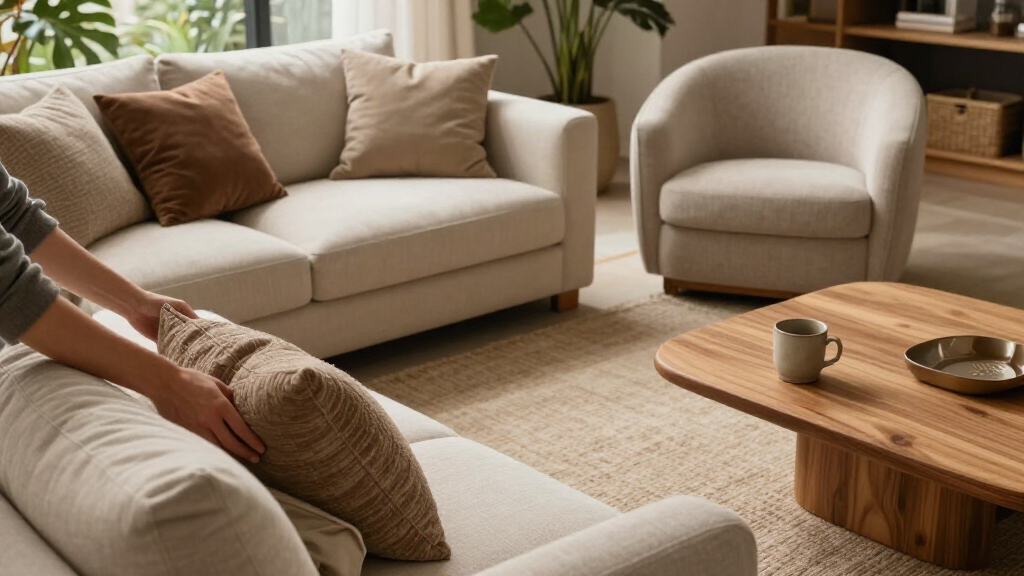
For a practical starting point, the report recommends choosing a focal point—such as a coffee table or rug—and arranging seating around it. Armchairs and smaller sofas can be angled into a loose square, while U-shaped couches and curved sectionals naturally form an inward-facing arrangement. Bookcases, sideboards or library tables can help define the seating area’s edges.
The approach offers homeowners a way to change how a living room is used without committing to a costly or permanent renovation. A conversation pit can create a defined gathering place, but its sunken floor and fixed dimensions may constrain later changes. A furniture-led arrangement can be adjusted as household needs, room use or furniture change.
That flexibility matters for people who want a living room to support hosting, games or everyday conversation as well as screen viewing. The design does not remove the television or prescribe how a household should spend time; it shifts the room’s default orientation. Its practical appeal is that the change can be tested by moving existing furniture rather than carrying out construction.
As an affiliate, we earn on qualifying purchases.
From Sunken Pits to Movable Seating
Conversation pits became widely used in the 1950s, according to Hunker. Typically, they are sunken sections of a living room lined with cushions and arranged around a central table. Their lower, enclosed seating was intended to make gatherings feel more intimate.
The same built-in quality can also be a drawback. Hunker notes that sinking a floor makes the arrangement difficult to change and that a pit may pose a tripping hazard. The report places the furniture-based alternative within a broader design interest in human-centered rooms, but it does not provide survey data or other evidence showing how widespread the shift is.
“Conversation-first living rooms are all about designing a space that encourages people to connect with one another, rather than focusing everything around a screen.”
— Monika Puccio, furniture expert, in an interview with House Beautiful
How Widespread the Shift Is
The source material describes a design approach and its potential benefits, but it does not establish how many households are adopting it or whether it is a measurable trend across the interior-design market. It also does not provide cost comparisons, room-size guidance or evidence that a particular seating layout improves social interaction for every household.
The suggested arrangements are design options, not fixed rules. The best layout will depend on the room’s dimensions, entrances, circulation paths and how residents use the space. Hunker’s report does not identify a single required furniture configuration.
Try the Layout Before Committing
For readers interested in the approach, the next step is to test the arrangement with existing furniture: select a focal point, turn seats toward one another and check that people can move through the room comfortably. The layout can then be adjusted before buying new furniture or making permanent changes.
No formal rollout, industry announcement or next milestone is identified in the source report. The idea remains a flexible home-design suggestion rather than a construction standard or a claim that conversation pits are disappearing.
Key Questions
What is a conversation-first living room?
It is a living-room layout that turns seating inward toward other people, often around a table or rug, instead of orienting every seat toward a screen.
Does this design require a sunken floor?
No. The approach uses movable furniture to create an intimate seating area and does not require building a traditional conversation pit.
What furniture works for an inward-facing layout?
Armchairs and smaller sofas can be angled toward one another. U-shaped couches and curved sectionals can also form an inward-facing arrangement, according to Hunker’s report.
How can the seating area be organized?
Choose a focal point, such as a coffee table or rug, and arrange the seats around it. Bookcases, sideboards or other furniture can help mark the area’s boundaries.
Is this a confirmed widespread interior-design trend?
The report describes the approach as part of changing design preferences, but the source material provides no adoption figures or other data establishing how widespread it is.
Source: rss
Columbus Day / Indigenous Peoples' Day Picks
long weekend sales
As an affiliate, we earn on qualifying purchases.