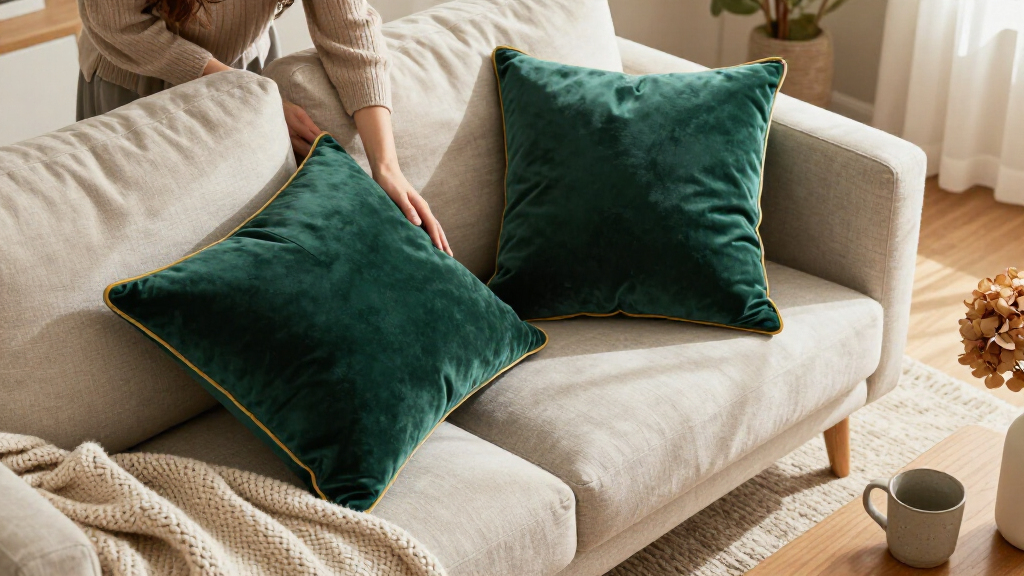

This guide walks you through the complete process of choosing, arranging, and caring for luxury velvet throw pillows so they look intentional and polished rather than mismatched or flattened. You will learn how to measure your furniture, pick the right pillow sizes and quantities, evaluate velvet quality before you buy, build a color and texture palette that works with your existing decor, arrange pillows correctly on sofas and beds, and maintain the pile so the pillows keep their shape and sheen for years. The guide is written for beginners — no interior design background is required. Expect the shopping and selection phase to take one to two hours, the arrangement itself about 20 minutes, and a short monthly maintenance routine thereafter. By the end, you will have a styled seating or sleeping area where the velvet pillows read as a deliberate design choice, with even pile, visible sheen, and balanced placement.

Get furniture and decor delivered free with Prime
- Fast, free delivery on millions of items
- Prime Video, Amazon Music and more included
- Member-only deals all year

Aeckself European Luxury Velvet Throw Pillow Cover, 18 x 18 Inch
- ✔ Brand: Aeckself
- ✔ Material: Velvet
- ✔ Size: 18 x 18 inches

AIBU HOME 20×20 Cream Cut Velvet Pillow Covers with Raised Texture
- ✔ Brand: AIBU HOME
- ✔ Material: Cut-pile velvet
- ✔ Size: 20 x 20 inches

HWY 50 Burgundy Red Velvet Throw Pillow Covers, 18×18 Inch, Pack of 2
- ✔ Material: 100% polyester velvet
- ✔ Size: 18 x 18 inches
- ✔ Quantity: 2 covers (no inserts)
Difficulty: Beginner | Time: 1-2 hours for selection and arrangement, plus 20 minutes of monthly care
What You’ll Need
Tools & Materials:
- Tape measure
- Notebook or phone for measurements and photos of your furniture
- Soft-bristle brush or lint-free microfiber cloth
- Garment steamer (for refreshing crushed pile)
- Access to fabric swatches or a retailer with a good return policy
Knowledge:
- Basic ability to measure furniture and note dimensions
- Familiarity with your room’s existing color palette and lighting
Before shopping, take a daylight photo and an evening photo of the room where the pillows will live. Velvet changes appearance dramatically depending on light direction — a pillow that looks deep teal in daylight can appear nearly black in lamp light. Having both photos on hand when you shop, especially online, will prevent costly mismatch decisions.
Aeckself European Luxury Velvet Throw Pillow Cover, 18 x 18 Inch
Of the three, this is the cover that most fully delivers on the word "luxury" in the title. The plush velvet base is good, but it’s the embroidered emerald-and-gold floral detailing that elevates it — compared with the HWY 50’s plain burgundy covers, the Aeckself reads as a deliberate decor statement rather than background filler. It’s the pick we’d center a sofa arrangement around rather than scatter as an afterthought.The construction holds up against its rivals too. The durable zipper closure feels more substantial than typical budget covers, and unlike the AIBU HOME option, this cover is machine washable, which matters for a dark, jewel-toned fabric where dust and marks show. The European styling suits traditional, glam, and maximalist interiors beautifully — but that’s also the tradeoff: if your space leans modern or Scandinavian, the ornate embroidery will fight your aesthetic rather than flatter it, and the neutral-textured AIBU HOME covers will fit better.The main practical drawback is shared across this entire roundup: it’s a cover only, with no insert included, so factor in the cost of an 18×18 insert. We also noticed the emerald-green tone can shift depending on screen and lighting, so if you’re matching it to existing curtains or a rug, order with some flexibility in mind.
Pros:
- Rich velvet paired with detailed emerald-and-gold floral embroidery
- Durable zipper closure built to outlast cheaper covers
- Machine washable — rare convenience for dark luxury velvet
- Strong focal-point styling for traditional and glam interiors
Cons:
- Cover only — insert not included
- Ornate European styling limits compatibility with modern decor
- Color may render slightly differently than on-screen photos
Best for: Buyers styling a traditional, glam, or jewel-toned living space who want one ornate statement pillow as a focal point.
Not ideal for: Modern or minimalist interiors where floral embroidery would clash, or anyone expecting a filled pillow ready to use out of the box.
Bottom line: The most complete luxury package of the trio — dramatic, well-made, and washable, provided your decor can handle the ornamentation.
“The most complete luxury package of the trio — dramatic, well-made, and washable, provided your decor can handle the ornamentation.”
AIBU HOME 20×20 Cream Cut Velvet Pillow Covers with Raised Texture
If the Aeckself cover is about color and ornament, this one is about touch and dimension. The true cut-pile velvet with raised 3D texture catches light differently as you move around the room, giving it a depth that flat velvet — like the HWY 50’s — simply can’t match. In our view, this is the fabric construction that most justifies a "premium" label, and it’s the reason cream, a color that could look bland on plain velvet, works so well here.Construction details are where AIBU HOME pulls ahead of both rivals: a concealed color-matched zipper that disappears into the seam, reinforced stitching at stress points, and no-shed, pill-resistant fabric. Anyone who has owned cheap velvet knows shedding is the failure mode that ruins the look within months, so this spec genuinely matters for longevity. The modern geometric pattern and neutral cream tone make it the most versatile styling choice of the three — it slots into contemporary, transitional, and even office spaces where the Aeckself’s embroidery would feel out of place.The tradeoffs are real, though. It’s the priciest-feeling single cover rather than a pair, so dressing a full sofa costs more than the HWY 50 route. Light cream velvet is also a magnet for pet hair and lint — far more visibly than the dark burgundy or emerald options — and the 20-inch size means you’ll need larger inserts than the other picks require.
Pros:
- Genuine cut-pile velvet with raised 3D texture for real depth
- Concealed color-matched zipper and reinforced stitching
- Shed- and pill-resistant fabric built to keep looking new
- Neutral palette and modern pattern suit nearly any interior
Cons:
- Cover only — 20×20 inserts not included
- Cream velvet shows pet hair and lint easily
- Costs more per pillow than multi-pack alternatives
Best for: Design-conscious buyers with modern or transitional interiors who prioritize tactile, dimensional fabric over bold color.
Not ideal for: Pet owners who can’t stay on top of lint removal, or buyers who want maximum coverage per dollar across a large sofa.
Bottom line: The best-built, best-feeling fabric of the group — choose it when texture and longevity matter more than bold color or quantity.
“The best-built, best-feeling fabric of the group — choose it when texture and longevity matter more than bold color or quantity.”
HWY 50 Burgundy Red Velvet Throw Pillow Covers, 18×18 Inch, Pack of 2
Styling a sofa with a single pillow rarely works — you need at least two or three — and that’s exactly where this two-pack of burgundy velvet covers shines. Where the Aeckself and AIBU HOME options give you one cover each, HWY 50 gives you a matched pair, making it the most practical route to a coordinated sofa arrangement without doubling your spend.The velvet here is ultra-soft and pleasant to the touch, but it’s honest to say it’s a simpler fabric than the AIBU HOME’s cut-pile construction — flat, plush polyester rather than dimensional texture. What you give up in refinement, you partly recoup in convenience: like the Aeckself (and unlike many premium velvets), these covers are machine washable on a gentle cycle, and the hidden color-matched zippers keep both sides looking polished from any angle on the couch.The rich burgundy tone is genuinely versatile — it works in traditional rooms alongside something like the Aeckself emerald, and holds its own in eclectic or bohemian spaces. Drawbacks to note: it’s covers only with no inserts, and the handcrafted construction means size can vary by 1–2cm, so a snug insert fit isn’t guaranteed. If your priority is maximum luxury per pillow, the other two picks outclass it; if your priority is a styled room on a sensible budget, this is the obvious choice.
Pros:
- Two covers included — best coverage per dollar in the lineup
- Ultra-soft velvet with a cozy, inviting hand-feel
- Invisible color-matched zippers for a clean look on both sides
- Machine washable with simple cold-cycle care
Cons:
- Simpler flat velvet compared with cut-pile premium options
- Covers only — inserts not included
- Handcrafted sizing can vary by 1–2cm between covers
Best for: Budget-minded buyers furnishing a full sofa or bedroom who want a coordinated pair of soft, richly colored velvet pillows.
Not ideal for: Buyers chasing the most premium texture and construction, or anyone who needs guaranteed exact sizing.
Bottom line: The smart pick for styling a whole space affordably — just don’t expect the dimensional texture of a premium cut-pile cover.
“The smart pick for styling a whole space affordably — just don’t expect the dimensional texture of a premium cut-pile cover.”
As an Amazon Associate we earn from qualifying purchases.
Before You Start
Set a realistic budget before browsing. Genuine luxury velvet pillows typically cost between $40 and $150 per pillow, with inserts sold separately in many cases. A set of four to six quality pillows is usually the goal, so decide your total spend first. Second, understand the difference between covers and inserts: most high-end pillows are sold as a cover only, and the insert you choose determines whether the pillow looks plump and expensive or limp and deflated. Plan to buy inserts one size larger than the cover — for example, a 20-inch cover gets a 22-inch insert. This single detail is the biggest driver of that full, “karate-chop” luxury look.
Step-by-Step Instructions
Step 1: Measure your furniture and decide pillow quantity
Measure the seat width of your sofa, sectional, or bed with a tape measure and write down the number. Then use these quantity guidelines: a standard 84-inch sofa takes 5 to 7 pillows, a loveseat takes 3 to 4, an armchair takes 1 to 2, and a queen or king bed takes 3 to 5 pillows for a styled daytime look. Do not fill the entire seat surface — leave at least one third of the seating area free so the pillows read as decoration, not storage.
Tip: More pillows does not mean more luxury. Overstuffed sofas read as cluttered. When in doubt, remove one pillow from your planned count.
Check: You have a written seat width measurement and a specific pillow count for each piece of furniture.
Step 2: Choose pillow sizes using a layered pattern
Select two or three different sizes rather than identical pillows. Use the classic layering formula: place your largest pillows (22 or 24 inches) at the back, medium pillows (18 or 20 inches) in front, and one small accent pillow (14 to 16 inches, or a lumbar shape) in the center or at one end. For a bed, use two or three euro squares (26 inches) against the headboard, followed by standard sleeping pillows, then one or two 20-inch velvet pillows in front. Order your sizes so each layer is visible above or in front of the one behind it.
Tip: Square pillows larger than 24 inches on a standard sofa start to look like floor cushions and get heavy to move daily.
Check: You have a size list such as “two 22-inch, two 18-inch, one lumbar” — not a list of identical sizes.
Step 3: Evaluate velvet quality before buying
When shopping in person, run your hand across the fabric surface and then against the direction of the pile. Quality velvet has a dense, soft pile that shifts color as your hand changes direction, springs back after being pressed, and shows no visible backing or bald spots. Check the fiber content on the label: cotton and silk-blend velvets have the richest hand feel, while high-grade polyester velvet (often labeled “crushed-free” or “performance velvet”) offers superior durability and stain resistance for homes with children or pets. When shopping online, zoom into product photos to look at the pile direction, read reviews for words like “shiny,” “thin,” or “see-through,” and confirm the return window is at least 30 days.
Tip: Order one pillow first if you are unsure. Live with it in your actual room lighting for a few days before committing to the full set.
Check: Your chosen pillow has a fiber content you can name, a return policy you have confirmed, and no bald or thin spots if you inspected it in person.
Step 4: Build a color and texture palette
Choose a palette of three colors maximum: one dominant color drawn from your existing decor (rug, art, or wall color), one deeper or lighter shade of that color for depth, and one contrast color in a smaller dose. In rooms with busy patterns, stick to solid velvet pillows; in rooms dominated by solids, one pillow in a tonal pattern or a contrast texture (linen, bouclé, or leather trim) adds interest. Jeweled tones — emerald, sapphire, burgundy, ochre, and deep plum — show velvet’s sheen best and are the safest luxury choices. Avoid mixing warm and cool versions of the same color, such as a rust pillow next to a berry one, unless they are clearly intentional opposites.
Tip: Photograph your fabric swatches or existing pillows next to your rug under daylight before ordering. Screens distort velvet color more than almost any other fabric.
Check: You can state your palette in one sentence, for example: “Cream sofa, dominant emerald velvet, lighter sage layer, and one rust lumbar.”
Step 5: Select inserts that are one size up
Buy pillow inserts two inches larger than each cover — a 20-inch cover gets a 22-inch insert, a 16-inch lumbar cover gets an 18-inch lumbar insert. Choose feather-down inserts for the softest, most luxurious sit with that slightly rounded “lived-in” corner look, or down-alternative inserts if anyone in the household has allergies. Insert the fill so the corners are fully pushed out, then close the zipper or envelope closure completely.
Tip: This is the step most people skip, and it is the difference between a pillow that looks like a hotel and one that looks like a dorm room. Budget for inserts from day one.
Check: Each finished pillow stands on its own when propped upright, with taut fabric and no sagging corners.
Step 6: Arrange the pillows on your sofa or bed
Place your largest pillows at both ends of the sofa, snug against the arms. Layer the medium pillows slightly in front and inward, overlapping the large ones by a few inches. Finish with the accent lumbar or small pillow at one end or in the center. For a symmetrical look, mirror the arrangement on both sides; for a more relaxed designer look, offset the final accent pillow to one side. On a bed, stand the euro pillows upright against the headboard, stack or lean the standards in front, and place the two velvet accent pillows at the front center or slightly offset. Step back five feet and view the arrangement from the main entry point of the room before finalizing.
Tip: Give each pillow one firm pat on top to settle the fill, and use the side of your hand to create a soft crease at the top center of large pillows — this detail instantly reads as styled.
Check: From across the room, the pillows form a visible layered triangle or symmetrical pattern, no pillow hides another completely, and roughly a third of the seating surface remains clear.
Step 7: Establish a care routine for the velvet pile
Once a month, brush each pillow with a soft-bristle brush in one direction to lift the pile and remove dust. If you notice flattened or crushed areas, hold a garment steamer six inches from the surface and pass lightly over the spot, then brush the pile back into position and let it air dry fully before use. Rotate pillows every few weeks so the same side is not always exposed to sunlight, which fades dye over time. Blot any spill immediately with a dry cloth — never rub, since rubbing crushes the pile into the stain.
Tip: Check the care label before any washing. Many velvet covers are dry-clean only; machine washing a silk or cotton velvet can permanently crush the pile.
Check: Pillows retain an even sheen and color across the whole surface, with no flattened patches or visible dust when viewed at an angle.
Common Mistakes to Avoid
- Buying all pillows in the same size — Use at least two sizes in a layered arrangement. Identical pillows lined up in a row look like showroom staging rather than styling.
- Skipping the oversize insert and using the cover’s exact insert size — Always buy inserts two inches larger than the cover. A correctly sized insert makes even a moderately priced cover look expensive.
- Choosing colors from a screen without checking the room’s actual lighting — Order one sample pillow or swatch first, view it in daylight and evening light in the room, then order the remaining pillows.
- Rubbing spills or machine washing velvet covers — Blot spills dry, steam and brush to restore pile, and follow the care label. Default to dry cleaning for anything other than labeled performance polyester velvet.
Troubleshooting
Problem: Pillows look flat and lifeless despite new covers
Solution: The insert is too small or worn out. Replace with inserts two inches larger than the covers, and prefer feather-down for a fuller shape. Pat and reshape the pillow after inserting.
Problem: Velvet shows visible lines, creases, or flattened stripes
Solution: This is pile crush and it is reversible. Steam the area lightly from six inches away, brush in one direction with a soft-bristle brush, and let it dry upright overnight.
Problem: The pillows look darker or duller in the room than they did in the store
Solution: Velvet reflects light directionally. Rotate the pillow 180 degrees so the pile faces the main light source, or move the pillow to a position where light hits it at an angle to restore sheen.
Problem: The arrangement looks cluttered or leaves no room to sit
Solution: Remove pillows one at a time until at least a third of the seat is clear. Store extra pillows in a basket or closet for seasonal rotation rather than crowding the furniture.
What Success Looks Like
Your task is complete when the following are true: your sofa or bed has a layered arrangement of two or more pillow sizes in a palette of three colors or fewer; each pillow stands plump with taut fabric and rounded corners thanks to oversize inserts; the velvet shows an even sheen with no flattened or faded patches; at least a third of the seating surface remains usable; and a photo of the arrangement from the room’s entry point looks balanced and intentional. When guests ask where the pillows came from, you have definitively achieved the look.
Next Steps
After completing the arrangement, take a reference photo so you can recreate the exact layout after washing or seasonal changes. Plan a rotation: swap accent colors twice a year — for example, ochre and rust tones for autumn and winter, cooler sapphires or greens for spring and summer — so you refresh the room without repurchasing everything. Add your monthly brushing and steaming session to a calendar reminder. If you later invest in a velvet sofa or armchair, reuse this guide’s color evaluation and care steps, since the same pile-direction and steaming rules apply to velvet upholstery.
Frequently Asked Questions
How many velvet throw pillows should I put on a sofa?
Five to seven for a standard 84-inch sofa, three to four for a loveseat, and one to two for an armchair. The count matters less than the layering — always use at least two sizes and leave about a third of the seat surface clear.
Is polyester velvet a real luxury option, or do I need silk or cotton velvet?
High-grade polyester velvet, often sold as performance velvet, is a legitimate choice and is the more practical one for households with children or pets because it resists stains and crushing. Cotton and silk-blend velvets have a richer hand feel and deeper color shift but demand more careful care. Match the fiber to how the furniture is actually used.
Why do my velvet pillows look like two different colors in photos?
Velvet’s pile reflects light directionally, so fabric brushed in different directions reads as different shades. Brush all pillows in the same direction before photographing, and arrange them so the pile faces the primary light source for consistent color.
Can I wash velvet pillow covers at home?
Only if the care label explicitly permits it, which is usually limited to performance polyester velvets. Use cold water, a gentle cycle, and air dry flat, then steam and brush to restore the pile. Silk and cotton velvets should go to a dry cleaner.
Do I really need to buy inserts separately, and can I reuse old ones?
Many luxury covers are sold without inserts, so yes, plan for that purchase. Reuse old inserts only if they are two inches larger than the new covers and still spring back when squeezed. Compressed, yellowed, or lumpy inserts will ruin the look of even the best velvet cover.
Fall Picks
fall essentials
As an affiliate, we earn on qualifying purchases.