TL;DR
Burlwood is seeing renewed interest in home design, with four designers interviewed by Design Milk describing how they are using its naturally varied grain in contemporary interiors. Their comments point to a preference for distinctive, collected-looking spaces, though the source does not provide sales data or evidence of how widespread the trend is.
Burlwood is returning to home design, but designers interviewed by Design Milk say its current appeal is less about reproducing period interiors than bringing distinctive grain and visual character into contemporary rooms. Four designers discussed the material’s varied appearance, the types they choose and the finishes they pair with it; the report does not quantify how widely the renewed interest has spread.

Get furniture and decor delivered free with Prime
- Fast, free delivery on millions of items
- Prime Video, Amazon Music and more included
- Member-only deals all year
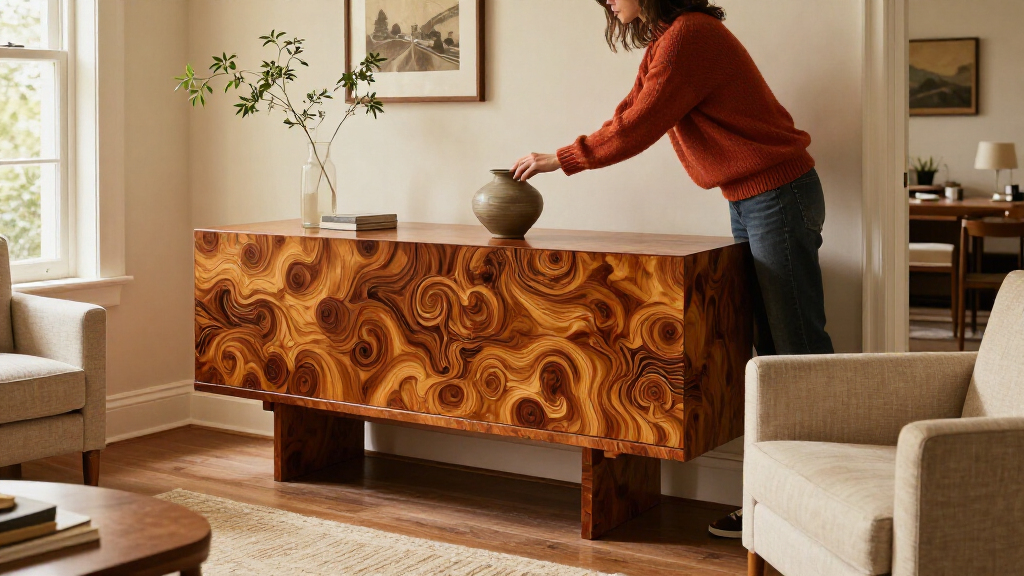
Burlwood comes from rounded growths, or burls, that develop on tree trunks or branches. The resulting wood can have tightly packed swirls, knots and irregular markings. Because the grain varies from piece to piece, even objects made from the same kind of burl can look markedly different. Tiffany Brooks, principal designer of Tiffany Brooks Interiors, compared its visual role to a strong print: the detail draws the eye up close, while the surface can read as a unified field from farther away.
The designers described burl as an alternative to relying on patterned textiles for visual interest. Abbe Fenimore, owner of Studio Ten 25, values its organic character, while Eddie Maestri, founder and creative director of Maestri Studio, said the irregularities are part of the attraction. Mimi Meacham, founder and principal designer of Marian Louise Designs, said the specific piece matters more than choosing a species by name: its color, scale of figuring and finish all affect how it works with a furniture shape.
The designers named walnut, maple and mappa burl as options with different visual effects. Brooks uses walnut for depth, maple for a lighter palette and mappa when she wants a bolder pattern. Maestri favors mappa, also called poplar burl, for its lighter, golden tone. Their suggestions for accompanying materials include brass, linen, velvet, stone and plaster, with colors such as blue, green, aubergine, olive and ochre. These are individual design preferences, not a single prescribed palette.
Burlwood Returns to Home Design With a Fresh Look
Four designers describe using burlwood’s distinctive grain in contemporary interiors. Their examples show design possibilities, but the report does not measure how widespread the trend is.
Why the grain stands out
Burls create irregular swirls, knots and markings, so each piece has its own visual character.
A focal point in the room
Burl can add visual interest without relying on patterned textiles everywhere.
Collected, not matched
Designers see burl as a way to give modern rooms warmth and a sense of character.
Choose by the piece
Color, grain scale, furniture shape and finish all affect how burlwood works in a room.
| Type | Designer-described effect |
|---|---|
| Walnut | Deeper look |
| Maple | Lighter palette |
| Mappa (poplar) | Bolder, golden grain |
Balance or heighten the pattern
The designers offer different styling options, not a universal formula.
- Matte paint
- Linen or softly textured fabric
- Stone and plaster
- Brass or lacquer
- Velvet
- Blue, green, aubergine, olive or ochre
A material that returns
Burlwood has appeared across multiple periods; contemporary designers adapt it to current rooms and furniture forms.
A Distinctive Look for Modern Rooms
The renewed attention matters to readers because burlwood offers a way to add a natural focal point without making every surface or fabric carry a print. Its markings can make a chest, table or console visually prominent, while the surrounding room can stay restrained. Designers’ examples also show that burl is not limited to a particular furniture silhouette: it can appear in a traditional detail or alongside curved forms and contemporary lines.
The designers connect the material’s appeal to interest in interiors that feel personal rather than assembled from a single reference or matching set. Brooks said homeowners may be tiring of rooms that look as if they came from the same inspiration board. Fenimore sees burl as able to bridge modern and vintage styles, giving a new piece a sense of having been collected over time. Those are the designers’ assessments; the source offers no survey or market figures establishing a broader shift in homeowner preferences.
For people considering burlwood, the comments suggest treating it as a material with its own strong pattern. A room can balance that pattern with matte paint, softly textured fabric or simpler forms, or heighten the contrast with lacquer, brass and color. The choice depends on the wood’s tone, the size of its markings and the finish of the piece.
Products Worth Considering

Google Nest Thermostat E Smart Thermostat with Temperature Sensor Bundle – White

eufy Security eufyCam C37 4-Camera Kit with 360° Pan and Tilt, Auto Tracking, 2K Video, and Solar Panels

Levoit Core 400S-P Smart Air Purifier for Large Rooms
As an affiliate, we earn on qualifying purchases.
From Art Deco to Current Interiors
Burlwood has appeared in several periods of furniture design. The source traces its popularity to the Art Deco era of the 1920s and 1930s, followed by a prominent place in furniture design during the 1970s. It describes today’s interest as another return, with designers adapting the material to present-day spaces rather than simply recreating earlier looks.
Maestri also pointed to burlwood’s longer history, including its use by French cabinetmakers. In his view, its repeated returns reflect enduring interest in warmth and handmade character. The material’s irregular grain helps explain why it can read as both old and new: the markings carry a natural, varied quality, while designers can use them on furniture with contemporary shapes and pair them with current color schemes.
The report illustrates that range with examples including a bookmatched chest, a burlwood nightstand in a modern bedroom and a curved console. These examples show how grain can be used across different furniture forms, but they do not establish how common burlwood is in homes or retail collections.
““It gives your eye somewhere to go.””
— Tiffany Brooks, principal designer of Tiffany Brooks Interiors
How Broad Is the Burlwood Revival?
The source describes a renewed design moment but does not provide a publication date, sales figures, search data or other measurements showing its scale. It is not clear whether interest is concentrated among designers and editorial projects or is also reflected in wider consumer demand. The report also does not identify particular manufacturers, new product launches or changes in furniture availability.
Design recommendations are attributed to individual designers and should not be read as universal rules. The source does not compare the durability, cost, sourcing or maintenance needs of different burlwood species and finishes. It also does not specify whether every pictured piece uses solid burlwood or a veneer.
Designers Put the Grain to Work
The report’s practical takeaway is to judge burlwood as part of a specific piece, considering its color, grain scale, shape and finish together. Designers suggest balancing pronounced markings with matte or tactile surfaces, or pairing them with brass, lacquer and carefully chosen colors. Readers interested in the trend can look for how those details work in a full room rather than treating the wood species alone as a guide.
No product announcement, market forecast or follow-up milestone is included in the source. Whether this renewed attention grows beyond the designers’ current projects remains to be seen; evidence such as retail data, new collections or further reporting would be needed to establish the trend’s reach.
Key Questions
What is burlwood?
Burlwood comes from burls, rounded growths found on tree trunks or branches. Its grain often has swirls, knots and irregular patterns that make each piece visually distinct.
Which burlwood types did the designers discuss?
The designers named walnut, maple and mappa burl. Brooks associated walnut with a deeper, moodier look, maple with a lighter palette and mappa with bolder grain. Maestri said he favors the golden tone of mappa, also known as poplar burl.
How do designers suggest styling burlwood?
Suggestions include pairing it with brass, linen, velvet, stone or plaster, and using colors such as blues, greens, aubergine or ochre. A matte wall or textured fabric can balance a glossy surface, according to the designers interviewed.
Is burlwood’s comeback supported by market data?
Not in the source material. Design Milk reports designers’ observations and preferences, but provides no sales figures or other data measuring how widespread the renewed interest is.
Source: design-milk.com