
TL;DR

Get furniture and decor delivered free — and shop member deals
- Fast, free delivery on millions of items
- Access to Prime Big Deal Days deals on October 6–7
- Prime Video, Amazon Music and more included
Designers featured by Livingetc describe a growing use of angular kitchen islands, from subtly clipped rectangles to more sculptural forms. They say the shapes can respond to a room’s architecture and help keep walkways open, though storage, seating and appliance clearances require careful planning.
Designers are using angular kitchen islands in a growing range of interiors, according to a report by Livingetc, which says the shapes can respond to a room’s architecture and help guide movement through the space. The designs range from clipped corners on rectangular islands to more sculptural forms, but they can make storage, seating and appliance clearances more complicated.
The report traces its interest in the trend to a “chopped” island by Polish design studio Akurat. Studio founder and creative director Maciej Ryniewicz said the project’s irregular room called for an island shape that would sit comfortably with the surrounding architecture. He said the team offset the directions established by the walls so the island worked from different approaches.
Livingetc says it has since seen angled islands in more designers’ projects. Some make a small adjustment to a rectangular block; others use a more pronounced geometry. Designers interviewed for the report describe the island as an opportunity to give a kitchen a focal point, with shape doing much of the visual work.
Atelier Alwill director Romaine Alwill said her own island took detailed adjustments to meet a family’s needs. Legroom, dishwasher placement and storage all needed fine-tuning. She said leaving the island without a sink helped, while the room’s available space allowed the design to extend further at its angles.
How Angles Can Shape Kitchen Movement
The designers’ case for angular islands is both visual and practical: a shape can echo details in the building while changing how people move around a kitchen. In a Belgian home described in the report, owner Eline De Bruyne said the angled sides and curved edge helped keep the walkway open and balanced the island’s large volume. That is a project-specific account, rather than evidence that every angled island improves circulation.
For homeowners, the examples suggest that the island’s outline can be part of the room plan, not simply a decorative choice. A shape that responds to windows or an irregular footprint may help a large kitchen feel more considered. The trade-off is that non-standard dimensions can make it harder to fit seating, work surfaces, storage and appliances. Those needs have to be resolved in the design.
From Irregular Rooms to Sculptural Forms
Kitchen islands are familiar work and gathering surfaces, but the report presents them as features designers are increasingly willing to shape more freely. Akurat’s project set an early reference point for Livingetc: the island was designed in response to a room with an irregular plan, rather than as a standard rectangle placed within it.
Other examples in the report show different reasons for using angles. In an Australian home, Alwill drew on chamfered details in the front windows and carried that architectural idea into the island. A Belgian project combined angled sides with a curved edge. In a Madrid project by Plutarco, a hexagonal island in terrazzo and wood used contrasting materials while keeping its geometric shape prominent.
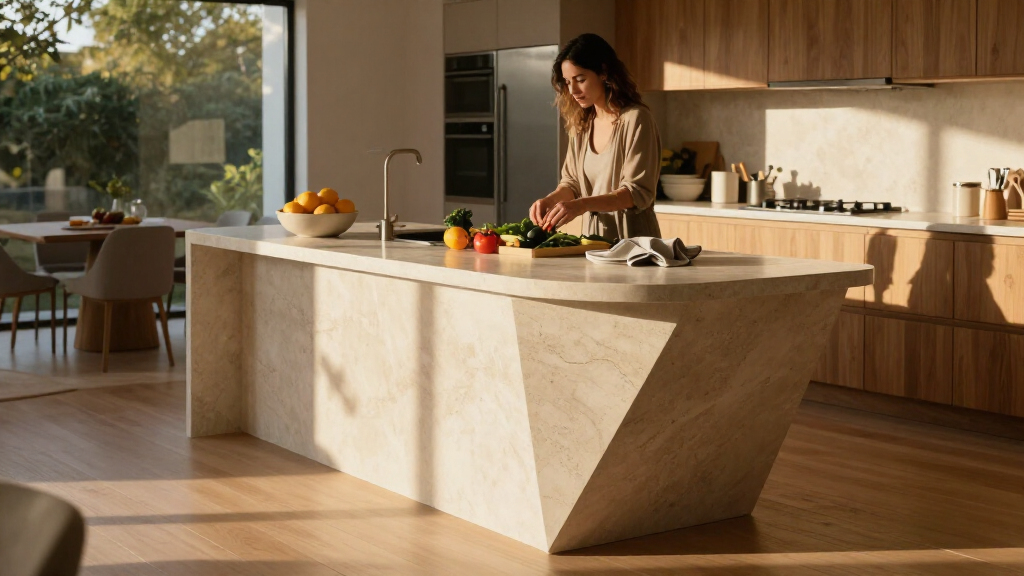
Studio Duggan’s marble island offers a more monolithic interpretation, with a bevelled underside and pedestal-like base. The supplied report excerpt ends partway through the designer’s description of the stone, so further details about that project are not available here.
““We were faced with a challenging space that was highly irregular in shape.””
— Maciej Ryniewicz, founder and creative director of Akurat
What Each Kitchen Design Must Resolve
The report does not provide measurements, cost comparisons or performance data comparing angular islands with standard rectangular ones. Its claims about improved flow and visual balance come from designers describing individual projects; the results will depend on room dimensions, the island’s placement and the household’s needs.
It is also unclear how widely the trend is being adopted beyond the projects Livingetc selected. The report identifies examples but does not give market figures or a timeframe for how quickly the designs have become more common. The supplied excerpt also cuts off during the account of Studio Duggan’s marble island.
Planning the Island Around Daily Use
For anyone considering an angled island, the next step is to work through the kitchen’s layout with a kitchen designer or architect. The plan needs to account for walkways, seating, legroom, storage, work surfaces and appliance doors before the shape is finalized. Alwill’s account indicates that leaving a sink off the island and having enough room to extend its depth helped make her design workable.
Whether the form suits a particular home will depend on those practical details as much as on its appearance. The report offers no broader forecast or follow-up milestone; its examples show how designers have handled the trade-offs in individual kitchens.
Key Questions
What is an angular kitchen island?
It is an island with a shape that departs from a standard rectangle, such as clipped or bevelled corners, angled sides or a polygonal outline.
Can an angular island improve movement through a kitchen?
It can be designed to preserve or guide a walkway in a particular room. The Livingetc report includes a homeowner who said her island’s geometry helped keep the passage open, but the result depends on the kitchen’s dimensions and layout.
What practical issues should be planned for?
Designers cited legroom, seating, storage, work surfaces and dishwasher placement. The shape and available space determine how those features can fit.
Do angular islands need bold materials?
No. Atelier Alwill’s Romaine Alwill said she often uses neutral stone so the form remains the focus. Other examples in the report use terrazzo, wood or marble.
Source: rss
Fall Picks
fall essentials
As an affiliate, we earn on qualifying purchases.